When Responsibility Becomes a Task - Activating the Protagonist Mindset


Translated by AI
Only a Perspective Shift Divides Pressure and Tasks
At a certain life stage, responsibilities become a relay race, passed on one by one. Work, family, relationships, and self-improvement—all require exploration without a complete guidebook.
Many falter here, feeling exhausted, pressured, and incapable of learning. After discussing the "Peter Pan Syndrome" and "Multiple Versions of Self" in previous essays, we comprehend why responsibilities weigh us down. Different internal age layers voice themselves in the same situation. Some wish to flee, others want to charge, some strive, while others prefer letting go. These mixed reactions naturally obscure clear direction.
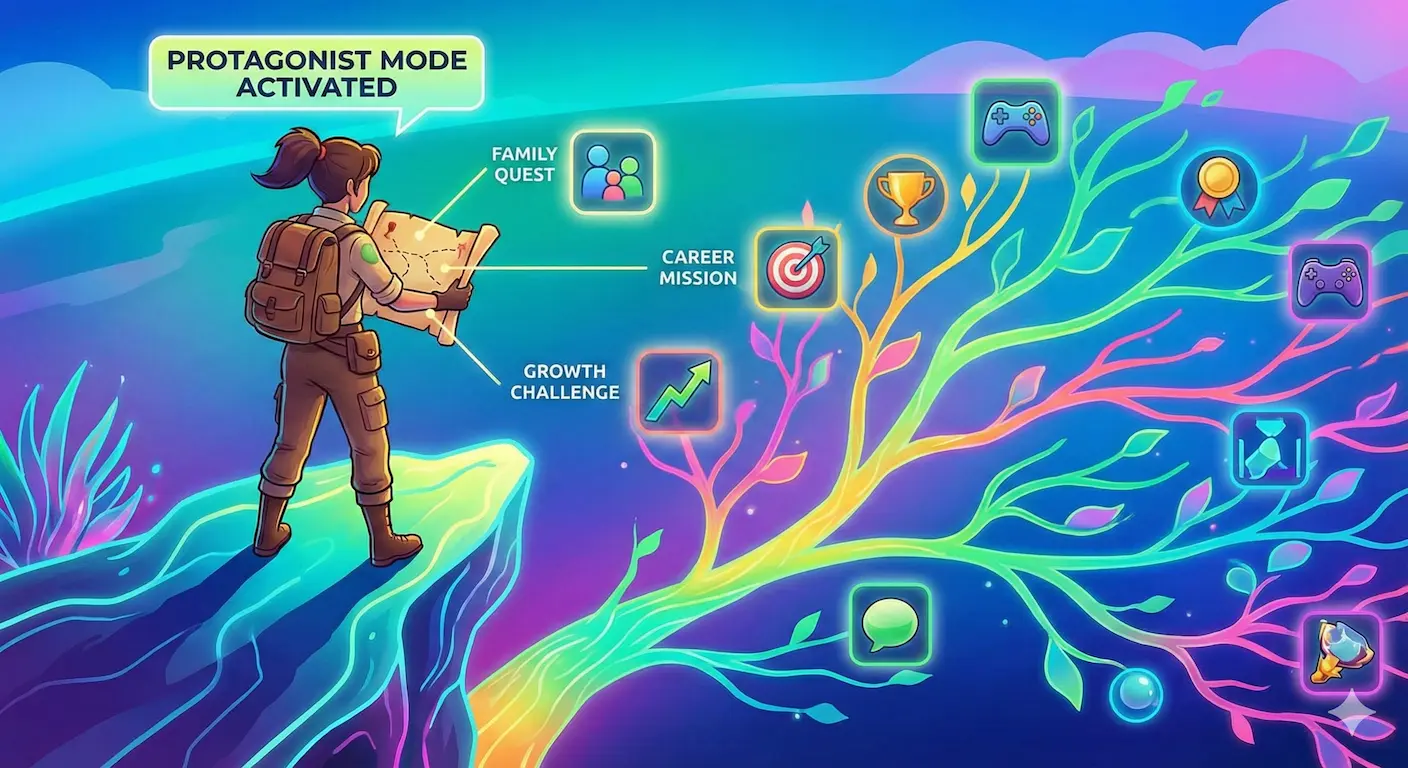
In the "Life Interns" viewpoint, responsibility isn't pressure but resembles game "task prompts." Tasks exist, but solutions are selectable, and the pace and mood are up to the player.
In the context of the Peter Pan syndrome, responsibility leads to constriction and confinement. However, in the "Life Interns" lexicon, it assumes an alternative form: offering paths, meaning, and potential for the next upgrade. A perspective shift transforms pressure into tasks, offering space to explore “how to play."
Game Settings: Responsibility as Task Modules
Within the "Life Interns" setup, "responsibility" is analogous to game task modules. From birth, everyone possesses basic task kits: family, health, social, and relational aspects. Age uncovers side quests: ideals, finance, creativity, love, objectives, networking, and collaboration.
These tasks can't be completely dismissed or bypassed, but you can adjust the content and approach, much like customizing difficulty, strategy, and gear in games. Here, speed of completion isn't the focus but rather:
- What terminology defines these tasks?
- How do we choose to accept and engage with them?
Protagonist Mindset: Responsibility as Player's Authority
Life features two primary roles: NPC and protagonist. NPCs follow external orders, executing tasks void of choices or adaptability. Conversely, protagonists have a distinct approach, selecting and defining tasks, fulfilling them uniquely. From this angle, responsibility transforms into "authority," ours to direct if embraced.
Gaming analogies aptly explain: beginners lament task difficulty, while adept players leverage each task to refine skills. Such disparity arises in reality too, where accepting tasks imparts capacity for adjustment, detours, or growth.
Transforming Responsibility's Energy: From Burden to Fulfillment
Psychologically, a curious trend occurs: "must-do" becomes "opt-to-do" shifting energy from anxiety to activity. Converting "responsibility" to "task" involves three steps:
- Identify: Which task lane am I addressing now? Family, work, finance, or internal growth?
- Rename: What does this truly mean to me? A seemingly stressful aspect may pertain to fulfillment or breakthroughs.
- Set Goals: Viewing it as a task, what do I hope to enhance? Patience, skills, courage, boundaries?
Clarity of tasks steadies emotions. Life fragments reconstruct a map, and a pathway surfaces. With this lens, experiences become malleable, coherent, and interconnected—not chaotic fates but chapters ready for unfolding.
Integration: Responsibility as Gaming's Core Mechanism
In "Life Interns," adulthood is never formally attained. We transition from one task to another, gradually augmenting. Players venture onward, harmonizing different self-layers: childlike curiosity, youthful vigor, adult commitment, seasoned wisdom.
Responsibility acts as an energy rune, adding weight yet enabling character growth. It's motivational fuel and pivotal for assuming protagonist roles. As tasks crystallize, inner child elements gain presence: freedom, exploration, responsibility—it's the protagonist's domain.
Growth doesn't entail abandoning childhood but discovering one's rhythm in the task system. With responsibility as a task, player paths widen, enabling narrative progression at one's chosen pace.
文章發布於