Childlike Spirit is Not Regression, But Integration


Translated by AI
Where Did Childhood Go When We Matured?
At times, life presents moments that cause us to pause. An old tune that transports you back to primary school, the scent of raindrops on the pavement, or the overwhelming urge "I want to hide" under mounting work pressure.
These seemingly sudden reactions are echoes from our younger selves.
The concept of the "inner child" is often invoked to remind us to retain our purity. Within the life intern paradigm, this child doesn't require awakening because they were never lost. Instead, they reside in a different niche in our hearts, surfacing during our busiest, most tense times when we crave a fresh breath.
Innate Childishness as a Core Module
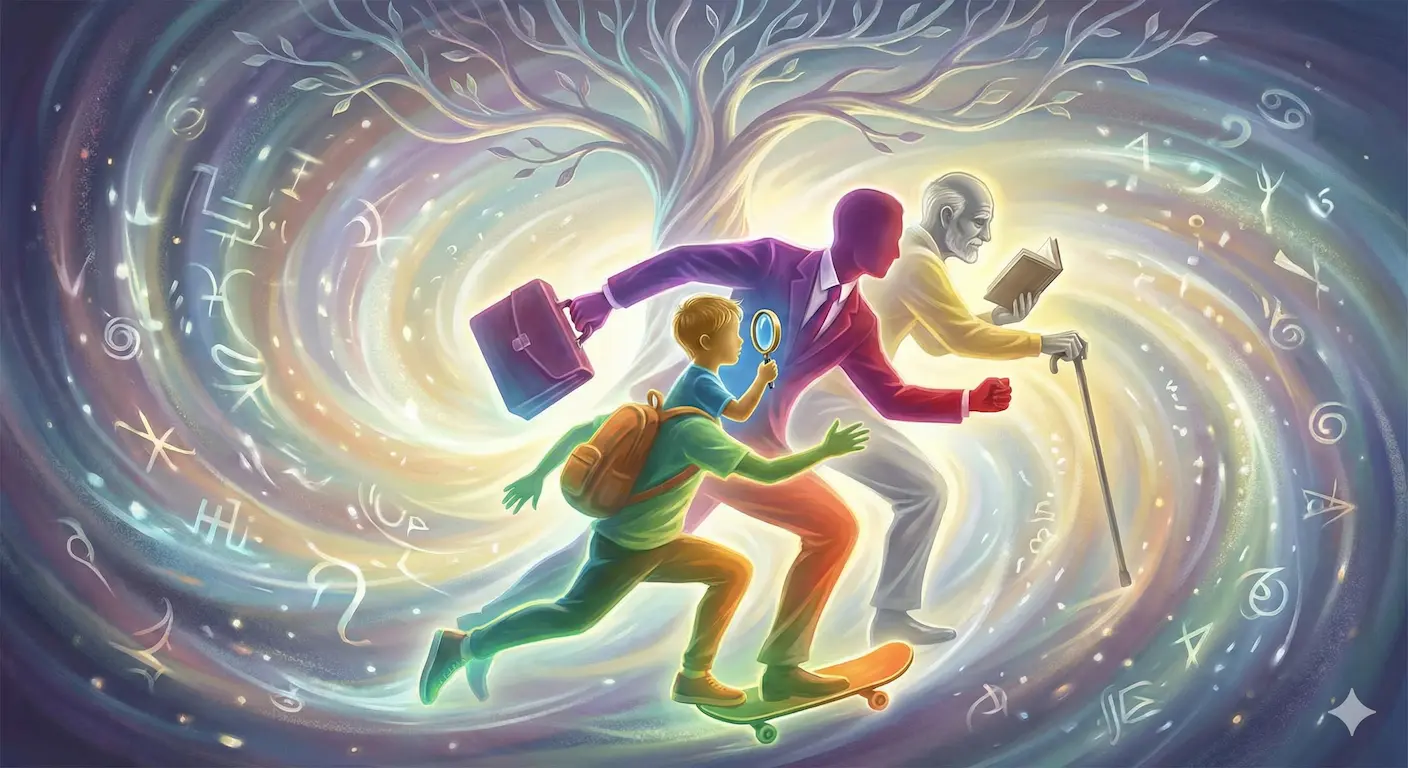
A principal tenet of the life intern is the "multi-version self." We are not engaged in a linear progression toward adulthood but in continuous self-integration.
- At 5: Curiosity reigns, seeing the world as a playground.
- At 17: Testing boundaries, longing for freedom, ready to break through.
- At 30: Balancing reality with ideals.
- At 55: Mastering choices, relinquishing control.
These versions do not bow out; instead, they collaborate, weighing their influence at every juncture. Childlike wonder embodies the capacity for feeling, imagination, and creation—an enduring vitality hardwired into our existence. When these multiple selves are concurrently present, life gains depth and authenticity.
Navigating Socialization and Adult Facades
Upon entering society, we don the "adult" mask—steady speech, restrained emotions, matured conduct. This persona is vital, ensuring smooth interaction and personal armor. However, amid this, some inner voices grow faint—intuition stifled, curiosity minimized, sensations relegated. We analyze what we ought to do, sidelining what we truly wish to do.
The "adult veneer" emerges as an operational interface, with the multifaceted inner self still ticking beneath. When these dual forces collide, it ignites a duality of "I want to be free" versus "I must shoulder responsibilities." This paradox isn't an issue to eradicate; it's a nudge that both outer appearances and inner workings seek a part in life's decisions.
Synthesizing Innocence and Duty as Protagonist Essentials
Cultivating a protagonist mentality hinges not on sacrificing traits but synthesizing all abilities. The child component yields sensitivity and perceptiveness, the adolescent level exudes passion and vigor, the young adult phase bears responsibility and directives, and the elder stage offers insight and cadence. These dynamic elements coexist, akin to blending character attributes into a singular lead figure.
When we embrace accountability and receptivity, focus and playfulness, life's rhythm transitions from "endurance" to "synergy." Here lies a domain where task completion coexists with spirited vibrance.
Childlike Spirit Unlocks "The Next Life Stage"
The "childlike spirit" acts as a gateway to new chapters. With openness to re-experience, feel, and innovate, life becomes a reconnection with a familiar yet novel game. Through this lens, labels of "adult" or "child," "mature" or "naive" dissolve. Roles shift effortlessly, actions carry elasticity, and life blends duty with delight.
Genuine growth thrives in the interstice of liberty and obligation—fulfilling duties while preserving a playful essence. Such a condition surpasses rigid adult archetypes, aligning closer with authenticity. Every synthesis resembles a fresh start, roles advance, and we inch toward our true selves.
Maturity isn't about mimicking others but encouraging every layer of self to progress together.
文章發布於