The Museum of Normality


Translated by AI
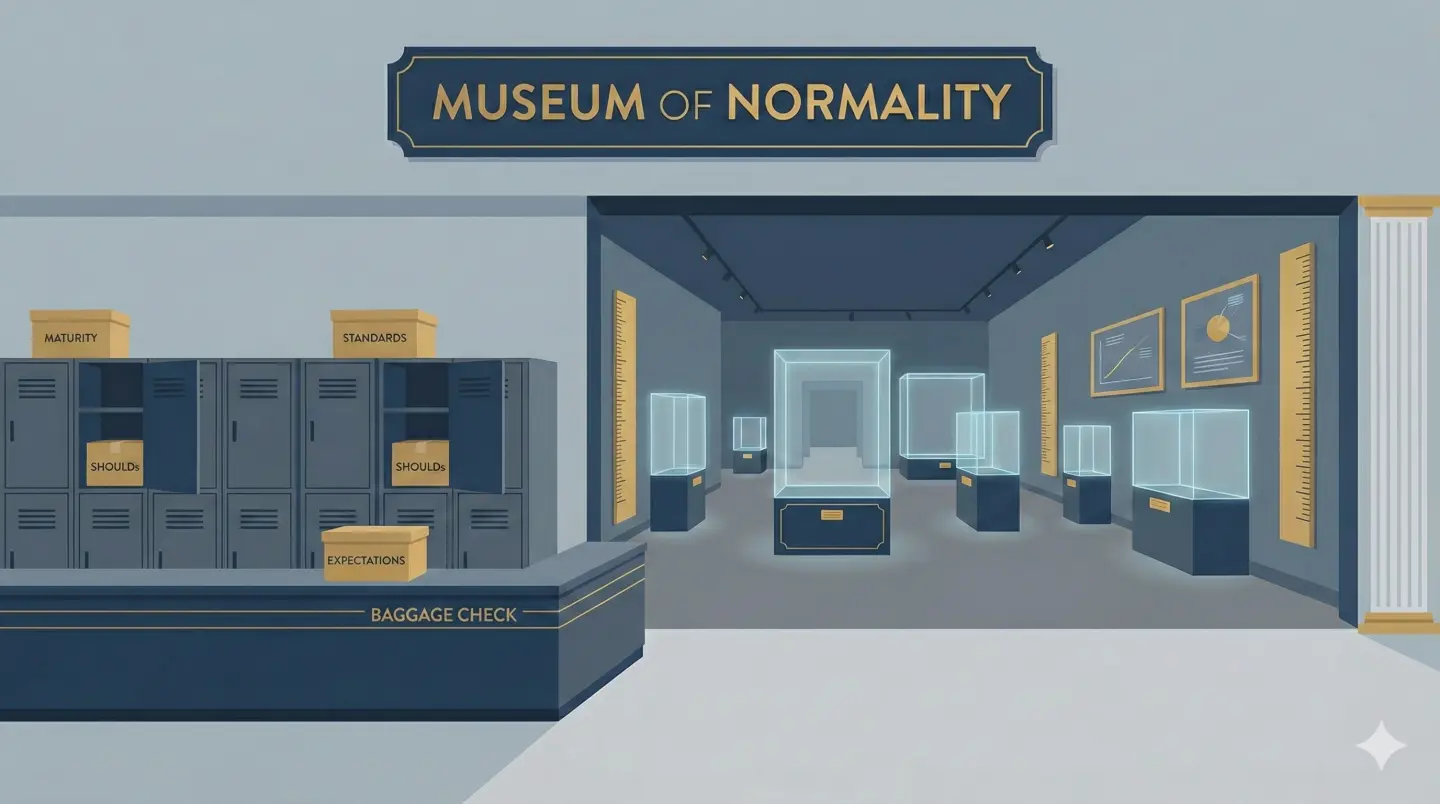
Welcome to the Museum.
Before you step inside, I must ask you to check your baggage at the counter. You know the sort: "Be good," "Act mature," "You should do this," "Normal people do that." You won't need them in here. Besides, if you carry them around, you might catch a glimpse of your reflection at a sharp turn and startle yourself.
Exhibition Theme | We Display the Frames, Not the Humans
You have heard the scripts: the elder putting down chopsticks with a sigh, "You need to grow up"; the doctor adjusting his glasses, "This is perfectly normal, don't worry." These phrases are like stamps—thwack-thwack—pressed onto your forehead like talismans. We don't display people here. We display the glass cases, the measuring tapes, and the placards that surround them. Come, see how these standards were nailed to the wall in the first place.
Hall 1: The Room of Measures | The Magic of Turning Flesh into Digits
A row of artifacts hangs on the wall: school report cards, health checkups, corporate performance reviews. The numbers stand in rigid formation, like an honor guard. Lean in closer, and you will see these figures stack up to form a wall; wherever there was a crack, it has been smoothed over with plaster.
Measures have their use; they give a chaotic life a baseline. But they have a foul temper: whatever they cannot measure, they treat as a defect. Do you remember? How many lamps you burned out staying up late, anxious over a single point difference, a single line of evaluation. What can be measured is not necessarily understood. The passing grade tells you if you survived the gate, but it never tells you where to go next.
Hall 2: The Labyrinth of Time | Four Clocks Vying to Define "The Adult"
In the display cabinets lie graduation photos, driver's licenses, marriage certificates, and the first pay stub. On the four walls hang four distinct clocks: the Biological, the Legal, the Emotional, and the Economic. Each ticks at its own independent speed.
You assume that turning twenty, thirty, or forty automatically unlocks some life level. In truth, you have simply swapped one ruler for another. Some learn to say goodbye at seventeen; others still cannot say "no" at fifty. Some only begin to grow up after their own children have fallen asleep.
The concept of the "Standardless Adult" reminds us that adulthood is not a destination you arrive at on a schedule. If you look back, you will see it is a history of bearing weight. The question is: When do we decide, "Can we pay the bill for our own choices?"
Hall 3: The Noise Control Room | Replacing "Perfect" with "Functional"
There is an engineering blueprint marked with "Tolerance"—the allowable margin of error. Beside it, a family calendar, rubbed raw by an eraser.
The machine of life is constantly vibrating. Emotions are background noise; relationships are gears; ideals are the RPM. The point is not perfect alignment, but continuing to run amidst the noise. If you lack strength today, lower the load. If words sting, dial the volume down to 70 decibels. "Functional" is far rarer than "Perfect." To keep turning within the gaps—that is the quiet technology I wish to master.
Hall 4: Borrowed Expectations | Living on Someone Else’s Ticket
The walls are plastered with aphorisms: ancient wisdom, corporate slogans, internet motivational quotes. They once guided you; they also once backed you into a corner for interrogation.
Standing before the mirror, you realize that the person desperate to prove themselves, desperate to fit in, is wearing a uniform thrust upon them without a fitting. Some "normalcy" is just a convenient way for others to manage you. Some "maturity" is just you learning to shut up. We need rules to live together, yes, but rules should be streetlights, not handcuffs.
Restoration Studio | Treating Cracks as Craft
A Kintsugi bowl, mended with fine gold lacquer. The card reads: Breaking is not the end; it is the structure speaking to you.
An adult is not someone without cracks; an adult is simply someone who knows how to mend them and dares to bear the consequences. The first step is not hiding the fissure, but admitting its path. Do I over-promise when nervous? Do I flee when conflict arises? We use the right glue and time to turn shards into load-bearing veins. Touch that gold line; you will find it warmer than the unbroken porcelain.
Exit Reminder
As you leave the museum, you will see the labels you deposited are still in the locker. You can take them home, or let them lie there. After all, their expiration dates have passed. You have learned to see the road with your own eyes.
Closing | Save the Ticket Stub for Tomorrow
Someone asks: "If there is no standard normal person, how do we relate to others?" I believe we rely on seeing that the other person can still hold themselves up, and on the willingness to co-write stories of responsibility.
Instead of jamming people into frames, use the frames as mere tools. Instead of chasing the "Finished Adult," practice living steadily in the present continuous tense. Understand how to survive the noise, know where reinforcement is needed, and know when to turn off the lights and sleep.
Outside, the sky is just right. Tuck the ticket stub into your notebook. I hope you make a secret decision: Starting tomorrow, no more applying for certificates of normalcy, no rushing for medals. Let us simply practice warming the lights, shortening the hallways, so that the people inside can finally begin to see one another.
And so, we continue to live. We haven't grown up; we've just grown older.
文章發布於